Thousands pay their last
respects to Ofra Haza in her old neighborhood -
By
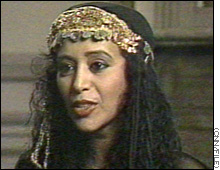
Michal Palti - Ha'aretz Correspondent - Popular singer Ofra Haza, who died Wednesday at
the age of 41,
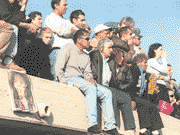
was laid to rest yesterday. Thousands filed past her coffin, placed in her native Hatikva
neighborhood in south Tel Aviv, to pay their last respects. Many then attended her funeral
at the Yarkon cemetery.
Among the thousands who came to pay their respects were Prime Minister Ehud Barak and his
wife Nava, Tel Aviv Mayor Ron Huldai, Deputy Education Minister Zevulun Orlev, Leah Rabin,
widow of prime minister Yitzhak Rabin, singers Shoshana Damari and Shlomo Artzi and
comedians Moni Moshonov, Dudu Dotan and Rivka Michaeli.
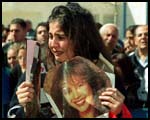
Thousands of neighborhood residents, some of whom had known Haza since childhood, and many
of the popular singer's fans were also present, and the security men posted by the Tel
Aviv Municipality were barely able to keep order.
Death notices posted across the neighborhood reported the passing of "Ofra Haza,
native of Hatikva neighborhood and the first lady of Israeli song."
Behind the coffin stood Ofra's sisters, her husband Doron, and the family's designated
spokesperson, Michal Ratzabi, who thanked the hospital staff on behalf of the family and
said: "This is very difficult for us. It is a very sad day for us all."
Tel Aviv Mayor Ron Huldai spoke of "the little princess from the Hatikva neighborhood
who grew up to captivate audiences with her pleasant simplicity and nightingale
voice."
Prime Minister Ehud Barak embraced Ofra's husband, and said that she "had become a
moving symbol of all that is good and noble in Israeli society."
After the speeches ended, Haza's coffin was loaded onto a car and a convoy of cars and
buses left for the Yarkon cemetery.
At 3 P.M. the funeral service began, with Haza's relatives - including her father, sitting
in a wheelchair - surrounding the open grave. Ministers Shimon Peres and Matan
Vilnai delivered eulogies.http://www3.haaretz.co.il/eng/htmls/kat6_3.htm
Nation says farewell to an icon - By Gil Hoffman - TEL AVIV (February 25) - "Shalom to you,
our
princess," said Ofra Haza's niece, Doreen, summing up the feelings of thousands of
fans of the late singing star who came from all over the country to her funeral yesterday
to bid her a final farewell.
Although the burial was attended by many celebrities, the crowd that followed the
motorcade from south Tel Aviv's Hatikva neighborhood, to the Yarkon Cemetery, where she
was laid to rest, represented more the Hatikva than the Hollywood in Haza's rags-to-riches
story.
Old and young, religious and secular, Sephardi and Ashkenazi, the people of all classes
who attended had little in common but the fact that they felt touched in some way by Ofra
Haza. The mix of people, united in tears around her grave, provided a final
testament to the impact of her music.
"The recordings, the movies, the CDs, the interviews, the wonderful performances in
Israel and throughout the world among the simple and the great are a living, breathing,
and enduring memorial to a real singer and woman," Doreen said.
Besides her songs, Haza also left behind countless unanswered questions about the
circumstances that led to her death on Wednesday, leaving her mourners to speculate about
what brought the 41-year-old singer to her grave.
On orders from Haza herself, the family continued to keep mum, preferring to celebrate the
singer's life rather than answer questions about the cause of her death.
Regional Development Minister Shimon Peres, Culture Minister Matan Vilna'i, and Tel Aviv
Mayor Ron Huldai joined singers Yardena Arazi, Shlomo Artzi, Shoshana Damari, Rami
Kleinstein, and Rita at the funeral.
Prime Minister Ehud Barak eulogized Ofra before the funeral as mourners gathered in
Hatikva, where she grew up and where her parents still live. Barak recalled worrying about
Haza 13 years ago, when she survived a plane crash.
"God brought her out of the fog, healthy and all in one piece, to touch more hearts
around the world," he said. "This time, God didn't intervene and we lost
her."
Quoting a couple of her top songs, Barak said that "as long as there is a child who
has Ofra's 'The Prayer' and 'Am Yisrael Chai' ringing in his ears, Ofra is not dead - she
is still with us."
At the funeral, Peres called Haza "a singer of hope for the nation and the
world" and thanked her for "making Israel a nation of song."
Vilna'i, a retired general, said he was used to speaking at the funerals of war heroes.
"You, Ofra, are the true hero of the culture of the nation of Israel," he said.
After the politicians had spoken, the microphone was given to two of Haza's nieces, Doreen
and Aya, who spoke from personal experience about the singer's impact on the nation, and
their family in particular.
"We're all here, trying to accept the fact that you won't be with us anymore,"
Aya said. "In heaven, they are standing at attention in your honor."
Ofra's family wailed as the grave was covered with earth and a pair of Yemenite rabbis
uttered the traditional prayers. "She was righteous and her judgment is
righteous," one said.
When the funeral ended, the crowd moved toward her grave, causing a near riot, each
mourner hoping for at least a moment to personally say thank you.
Haza's music blared from the cars making their way home.
Expert: Haza's request for
privacy like a living will - Background By Judy
Siegel - JERUSALEM (February 25) - Although the family of the late Ofra Haza has the
perfect right to bar the public
release of information on the cause of her death, the matter involves complex medical
ethics issues, says Rabbi Dr. Mordechai Halperin, head of the Schlesinger Institute for
Jewish Medical Ethics in Jerusalem.
"If a prime minister's health were involved, there would be justification for
explaining his condition, because his actions hold the fate of the country in his
hands," said Halperin. "But this is not the case here."
If the cause of Haza's death were some infection or if there were a suspicion of medical
negligence that posed a risk to the general public, the Health Ministry would have to
investigate and take action, Halperin continued.
If the cause had been a communicable disease and people had been in contact with her, the
uncertainty could cause panic, he said.
The mere fact that a seemingly healthy and active 41-year-old woman could succumb so
helplessly to an illness caused discomfort and anxiety among the public.
The ministry spokesman's office yesterday declined to comment, saying: "If there were
something the public had to know, we would tell them. It's in the hands of the
family."
Haza reportedly told her family and friends when she was admitted into the hospital that
information about her condition should not be made public.
"This is, in effect, a kind of oral will," explained Halperin. "That
makes her condition a kind of spiritual property. According to the rules of medical
ethics, such instructions should generally be observed, but if the situation changes
drastically - such as wild rumors that dishonor her
memory - it could be argued that the deceased herself would have changed her mind if she
had been alive. But one could consider ignoring the original instructions only in extreme
cases."
The Patients Rights Law stipulates that doctors may not release information about a
patient's condition without their or their family's consent, and it was this law that
prevented Sheba Hospital, which treated Haza in its respiratory intensive care unit for 13
days, from issuing any details about what caused her bodily systems to collapse so
catastrophically.
Sheba had refused, at first, even to confirm that Haza was admitted to the hospital, but
later - after wild rumors began to fly - the family agreed to provide limited information
about her condition, but not the cause of her illness.
The initial explanation, "complications of the flu that led to pneumonia," were
not repeated when Sheba deputy director Dr. Ze'ev Rothstein announced her tragic death.
After a week of treatment, the hospital expressed in the family's name their
"disgust over the many rumors among journalists and false lab results that supposedly
referred to Ofra.
"There is no truth to these rumors, and they are evil and baseless. All of us, her
family, friends, and the hospital, expect more responsibility and preserving privacy at
this difficult hour." But the family changed their tone when they noticed that the
press had not published any of the rumors.
Israelis mourn death of singer
Ofra Haza - February 24, 2000 - Web posted at:
1:40 p.m. EST (1840 GMT) - From staff and wire reports - TEL AVIV, Israel -- Israelis are
mourning the death of one of their first international pop stars, Ofra Haza. She was
41.
Haza, known for blending Yemenite melodies with techno music, was buried on Thursday in
Tel Aviv. She had died the previous evening at Sheba Hospital at Tel Hashomer of massive
organ failure, Dr. Zeev Rortenstein said. He refused to discuss what led to the failure,
saying that was her wish.
Haza had been in serious-to-critical condition for two weeks, unconscious and receiving
intravenous drug infusions and dialysis treatment. A recent article in the Jerusalem Post
reported she was believed to have developed pneumonia as a complication of untreated
influenza.
Her flag-draped coffin was on public display in Hatikvah, the poor Tel Aviv suburb where
she was born. Thousands of people flooded the town on Thursday to pay their respects,
including Prime Minister Ehud Barak.
"The songs of Ofra were not meant for only our ears. She entered the hearts of many
in Israel and throughout the world," Barak said in a condolence message. "Her
contribution to Israeli culture and the honor she brought to the country will be
remembered always."
Former Prime Minister Shimon Peres was among the crowd that attended the funeral Thursday
at the Yarkon cemetery. He praised Haza as a figure who bridged the traditions of east and
west.
Israeli radio played Haza's songs throughout the day, and all the major newspapers devoted
their lead stories to her. The county's largest paper,Yedioth Aharonoth, focused its first
seven pages on her life.
Haza was the youngest of nine children born to Yemenite immigrants. She had told a
television interviewer she grew up in a home that was filled with song -- her mother
having been a well-known singer in Yemen.
A talent scout discovered Haza at age 12. But it wasn't until 1983 that her career took
off. That year, she won second place in the Eurovision Song Contest with the song
"Ani od Hai" ("I'm still alive").
Two years later, she released "Yemenite Songs," which became an instant hit in
Israel. Its signature track, "Im Ninalu," ("If the gates of Heaven were
locked") expanded a devotional poem by 17th century rabbi Shalom Shabazi into a
modern love song. U.S. rap artists Eric B. and Rakim sampled "Im Ninalu" on
their dance hit "Paid in Full" in 1988, bringing Haza onto the international
scene.
Haza's 1993 album "Kirya" was nominated for a Grammy, and she had the honor of
performing in Oslo, Norway, when Israel's Prime Minister Yitzhak Rabin, then-Foreign
Minister Peres and Palestinian leader Yasser Arafat won the Nobel Peace Prize in 1994. She
most recently sang the role of Moses' mother in the 1998 film "The Prince of
Egypt."
PM Barak sends condolences to
family of Ofra Chaza - (IsraelWire-2/25)
Prime Minister Ehud Barak and Naava Barak on Wednesday night expressed their deepest
sorrow on the passing of Ofra Chaza and sent their condolences to her husband and family.
“I had the honor of knowing Ofra and I was impressed by her personality and
exceptional talents. The songs of Ofra were not meant for only for our ears. She entered
our hearts of many in Israel and throughout the world. Her contribution to Israeli
culture and the honor she brought to the country will be remembered always. We will
greatly miss Ofra, the woman and
artist,” Prime Minister Barak said. http://www.israelwire.com/
Funeral service for Ofra Chaza - (IsraelWire-2/24) The funeral for singing star Ofra Chaza will
begin in the HaTikvah neighborhood of Tel Aviv at 3:00pm and will continue to the Yarkon
Cemetery.
Chaza, 41, died on Wednesday evening of what is being described by medical officials as
systemic failure resulting from the flu. She was hospitalized for 13 days in an intensive
care unit prior to succumbing to the illness.
Singer Ofra Chaza succumbs to
illness at the age of 41 - (IsraelWire-2/24)
Internationally acclaimed Israeli singer Ofra Chaza died on Wednesday night at the age of
41.
In a prepared statement, it was learned that the star was pronounced dead by physicians at
the Sheba Medical Center at Tel HaShomer Hospital at 7:40pm. On Wednesday, it was
announced that her condition took a sudden turn for the worse, explaining she was
suffering from hepatic failure and her major biological systems had ceased functioning.
Medical experts also explained that Chaza’s body had succumbed to a systemic blood
infection and her major organs were beginning to breakdown.
The star was hospitalized for 13 days but a detailed explanation of her condition was
never released, with the family refusing to permit doctors to release information. Over
the 13-day hospital stay it was stated that Chaza was suffering from complication stemming
from the flu. During her stay, Chaza was admitted to the hospital’s respiratory
intensive care unit and was on life-support systems, including dialysis.
In the Wednesday night prepared statement, the Director-General of the medical facility,
Ze’ev Rothstein stated, "I am sorry to announce the death of Ofra Chaza."
Chaza, one of eight children from a Yemenite family began her career in 1979. In the
1980s, she began topping European charts where she was admired for her talents and songs
in several languages. In 1998, she was married to businessman Doron Ashkenazi.
Ofra Haza
Nov. 19, 1957 - Feb. 23, 2000
--------------------- We regret to announce that this evening at 7:40 PM (Israel time) Ofra Haza passed
away.
There are no words to describe the sorrow and grief we are experiencing at this moment.
We love you Ofra and we will miss you...
_______________________________
"Why do I cry at night?
Why do I feel so sad
Something holds me tight
it's something in the air
I have a prayer a prayer
A prayer from my heart
Night after night after daylight
Memories of home...."
_______________________________
Ofra Haza's Battle For Life - Dateline: 02/21/00 - Our prayers are turned to Ofra Haza. For
over a week the Israeli singer has been hospitalized in serious condition at the Sheba
Hospital in Tel Hashomer. Many rumors have been circulating speculating on what is
affecting Ofra. Occasional official reports have been released, only stating that
the condition was serious but not detailing anything else.
Bodyguards have been posted at the entrance to the Intensive Care ward of the hospital, to
keep away the many fans who have arrived there to wish Ofra well. Television cameras are
focused on the celebrities that have shown up, but at one point the family made a request
asking for no additional visitors.
Ofra Haza's story is almost Cindarella-like. She was born in the Hatikva quarter of Tel
Aviv, the youngest child of eight. When she was 12 she auditioned at a theater in the
neighborhood. Betzalel Aloni, the director of the troupe Ofra was trying out for,
immediately accepted her. Though Ofra's parents objected, Ofra soon became the star
of the group. At age 16 she participated in a Mizrachi song festival and took third
place.
Ofra was featured in Asi Dayan's 1979 film, Shlagger, and the song she sang in the film
quickly climbed to the top of the Israeli charts. Due to her image as a girl from the Tel
Aviv slums, few songwriters were willing to work with Ofra in those days; only Betzalel
Aloni gambled on her chances. In 1980 Ofra was chosen as Israel's Singer of the Year, a
title which she held for four successive years.
In 1983 Ofra won the Kedem Eurovision song contest, and went on to represent Israel in the
Eurovision with the song Hai. The song came in third place. In 1985, Ofra returned to her
roots when she recorded an album of Yemenite songs. In 1993 Ofra was nominated for a
Grammy with the international release of Kirya.
Though not as active in recent years, Ofra did sing for the soundtrack of Steven
Spielberg's The Prince of Egypt.
Ofra Haza has miraculously escaped death twice before in her life. In February,
1987, the Cessna plane in which Ofra was returning from a performance in Israel's south
made an emergency landing in the Hebron Hills. In April, 1994, Ofra was on an El Al flight
from London to Israel when the plane was struck by lightning. In both cases Ofra landed
safely.
Well-wishers flock to 'Ofraland' - By Gil Hoffman - (February 17) - The waiting room outside Ofra Haza's
hospital ward has become a shrine for a strange combination of psalm-saying rabbis,
alternative healers and die-hard fans of her music, all of whom feel somehow
connected to the singing star who rose from the slums of Tel Aviv's Hatikva neighborhood
to 16 gold and platinum albums.
The room in Sheba Hospital known as "Ofraland," is filled 24 hours a day with
visitors from all over the country, stacks of blankets for people who camp out there all
night and an impatient group of chain-smoking reporters on the "Ofra-watch,"
desperate for any tidbit from family
members who have kept details about her hospitalization a secret.
The latest word, announced yesterday by hospital officials is that Haza is still listed in
serious condition and breathing through a respirator, but is now out of danger. She is
being treated with drugs given intravenously and dialysis. The singer's husband, Doron
Ashkenazi, has remained at her bedside since she was admitted to the hospital Sunday after
a long battle with influenza.
Her spokeswoman, family friend Michal Ratzhabi, said that Haza is being kept sedated and
is unaware of the outpouring of support she has received. "The family appreciates the
worries, the love and especially the prayers," said Ratzhabi, who said Ofra is a big
believer in God.
The family said they are thankful to the hundreds of people around the world who have sent
letters of support to Haza's website - www.ofrahaza.com - and the countless phone calls
asking for Haza's mother's name - Shoshana, to be used as part of traditional prayers to
heal the sick.
Prime Minister Ehud Barak, former Prime Minister Shimon Peres and singers Shlomo Artzi and
Rita have been among the well-wishers on the phone, but the people who have come in person
are not big names, just average fans, who come to say a psalm and tell her family how much
she has touched them.
"I felt I just had to come," said 50-year-old Yoel Grady of Ramat Gan, who has
been to many of her concerts over the past 20 years. "My sister was in the army with
her but I really feel close to her because of her music."
A group of women approached the ward and gave Ratzhabi a phone number of a religious
healer, who they said saved their lives and is connected to Sephardi Kabbalist Rabbi
Yitzhak Kadourie.
"All the know-it-alls have come here from out of nowhere," a security guard
snickered, but Ratzhabi took the number and thanked them respectfully, telling them,
"we can use all
the prayers we can get." The Jerusalem Post - Internet Edition
Israeli singer Ofra Haza in
intensive care - February 17, 2000 - Web posted
at: 12:24 p.m. EST (1724 GMT) - From news and wire reports. TEL AVIV, Israel -- Ofra
Haza, the Israeli singer whose Yemeni melodies have made her known throughout the world,
is in serious condition at a Tel Aviv hospital. She is said to have developed pneumonia as
a complication of untreated influenza, according to a report in the Jerusalem Post.
In years past, Haza made it on to British pop charts and was No. 1 in Germany for weeks.
She recorded songs for Steven Spielberg's 1998 movie "Prince of Egypt."
"She is sedated in order to undergo medical treatment, attached to a respirator, and
her treatment includes drugs given intravenously and dialysis," Dr. Zev Rothstein,
deputy director of Sheba Hospital at Tel Hashomer, told the Jerusalem Post. "If there
is significant change in her condition, the hospital and family will issue a new
announcement to the press."
Haza arrived at the hospital earlier this week with a high fever. "The general
condition of Ofra continues to be serious," a hospital spokeswoman told Reuters.
"Ofra is still in danger." Haza's family, the Post reported, decided to
release information about her condition after rumors that she was on her deathbed spread.
Newspapers offered up headlines saying that "Ofra Haza is fighting for her
life," and "Ofra Haza's condition remains a mystery."
Since she's been in the hospital, some fans have posted Internet sites dedicated in her
honor, and others have camped outside the intensive care unit to pray. "I can't
accept the fact that she will pass away," one man told Reuters. "It can't be. I
can't accept it."
Haza, who is in her early 40s, was born in Israel to immigrants from Yemen, who lived in a
poor part of Tel Aviv. She was the youngest of nine children. She had told a
television interviewer she grew up in a home that was filled with song -- her mother
having been a well-known singer in Yemen.
Haza's career took off 17 years ago when she won second place in the Eurovision Song
Contest with the song "Ani od Hai" ("I'm still alive"). Her 1993 album
"Kirya" was nominated for a Grammy.
In Brief - Chaya Ofra Chaza
continues to fight for her life
(IsraelWire-2/17) 46-year-old singing star Chaya Ofra Chaza continues to fight for her
life in a respiratory intensive care unit of Sheba Medical Center at Tel HaShomer. Chaza
sustained systemic failure resulting from the flu and remains comatose on life-support
systems.
"Since Saturday night,
February 12th, Ofra has been in the Intensive Care Unit at Sheba Hospital at Tel Hashomer
in Israel. She is unconscious and is in a life
threatening situation. The media is making several speculations but the fact is that the
doctors are not releasing any information regarding the cause of her medical
condition. "All of her life Ofra was close to God and believes in him and we
can only ask God at this time to let Ofra remain here with us..." (updated: February
17, 2000)" http://www.ofrahaza.com
2/16/00: Please pray for Israeli/Yemenite singer Chaya Ofra Chaza
(Ofra Haza). She is known for her religious & pop singing, and has written many songs
about peace. She is currently in a coma on life-support from a deadly flu-virus in
Israel. Her family members & Jewish clergy are praying for her and reciting
Psalms at her bedside. Thank you very much. worldpeace@thefreesite.com
Increase noted in sales of
Chaza albums – Star remains hospitalized
(IsraelWire-2/16) In light of reports that singing star Chaya Ofra Chaza remains
in serious but stable condition in Sheba Medical Center, CD dealers report a marked
increase in sales of the star’s albums/ CDs over the past days.
Family members and clergy over the
past days have been reciting Psalms and prayers in the hospital, hoping the
internationally acclaimed Israeli star will make a total recovery.
Chaza, who remains
in a respiratory intensive care units is connected to a respirator as a result of systemic
failure and complications from the flu. http://www.israelwire.com/index.html
Rentgan Rabbi adds name to Ofra
Chaza f (IsraelWire-2/15) Rabbi Yaakov
Effergan, known as the "Rentgan" (X-ray) Rabbi, has added a name to singing star
Ofra Chaza, who continues to fight for her life in Sheba Medical Center in Tel Aviv.
The 46-year-old internationally
acclaimed Israeli star is listed in serious and stable condition in a respiratory
intensive care unit, connected to life-support systems, being treated for systemic
collapse resulting from the flu.
The star’s name is now Chaya
Ofra Chaza -- Chaya referring to life, taken from the Hebrew Chaim. It is in accordance
with Jewish tradition to add a name to a person who is critically ill for several reasons,
including our attempt to evade the ‘Angel of Death’ who may be seeking a person
with a specific name.
Ofra Chaza showing slight signs of improvement(IsraelWire-2/14) Singer Ofra Chaza remains in
serious condition in Sheba Medical Center and on Monday evening is reportedly still on a
respirator according to an IBA English News report.
The
internationally acclaimed Israeli singer, 46, is seriously ill as a result of
complications from a flu virus. http://www.israelwire.com/index.html
In Brief - Ofra Chaza listed in critical
condition in Israeli hospital (IsraelWire-2/14)
According to the daily Ma’ariv, 45-year-old internationally famed singing star Ofra
Chaza is in critical condition in an Israeli hospital. She is currently in an intensive
care unit on life-support apparatus as a result of complications from the flu.
Medical officials
at the Sheba Medical Center at Tel HaShomer explained that Chaza first came down with the
flu but her condition deteriorated and she is now battling a systemic condition, which has
compromised her respiratory system as well as other essential life-sustaining bodily
functions. http://www.israelwire.com/index.html
Essays -
if you have an essay about world peace, international friendship, human rights,
freedom, or a better world for all, please forward it to worldpeace@thefreesite.com
Why The World Needs A Functioning
And Successful International Criminal Court
I. Thesis statement: A functioning and successful
International Criminal Court is necessary to the cessation of war and ethnic hatred
crimes, which in turn are necessary to the survival of the planet and the human race.
II. United Nations
International Court of Justice
Universal Declaration of Human Rights
World War II & War Crimes
"Never again!"
Amnesty International
Specific countries in which ethnic hatred/war crimes occurred
during 1998
International Criminal Court
Why it needs to be successful
Conclusion:
Without a functioning and successful International
Criminal Court, the human race cannot evolve further. Enforced human rights and enforced
sentencing against war and ethnic hate crimes will eventually become human rights
tolerance, human rights acceptance, and human rights expectance; this is turn will make
the world a better place for all.
Works Cited
A functioning and successful International Criminal Court is
necessary to the cessation of war and ethnic hatred crimes, which in turn are necessary to
the survival of the planet and the human race.
The United Nations (UN) was created by the end of World War II.
Its purposes are to: (1) save future generations from war and related crimes; (2) reaffirm
faith in fundamental human rights; (3) establish and maintain justice of international
law; and (4) promote social progress and higher quality of life for all. ("Charter of
the United Nations" 2). The two main bodies of the UN are the General Assembly and
the Security Council. The General Assembly’s function is to discuss questions or
issues related to the Charter and make recommendations to the Security Council and UN
members. According to humor writer Dave Barry, the functions of the Security Council are
to "(1) Pass sweeping resolutions intended to end bloody conflict; and then (2) Veto,
ignore, or walk out on these resolutions." (Barry 122). Sadly, history has proven
that this does happen.
The principle judicial entity of the UN is the International
Court of Justice (ICJ), also known as the World Court. Both the Security Council and the
General Assembly are involved in cases tried by the ICJ, most of which are to decide on
treaty interpretations and settle minor international disputes. The ICJ limitations in
trying war crimes and war criminals are the defendant parties must willingly submit to the
World Court. For obvious reasons the offenders rarely do. Another limitation of the ICJ is
ruling enforcement –it has no power to do so. At best, if the person or country the
ICJ ruled against refuses to go along with the ruling, the claimant can complain to the
Security Council, which may make recommendations, or decide about possible
measures. It seems to be a lot of empty discussions and possible threats, but little or no
action, and almost no peace of mind for the victims. Not surprisingly, this does little to
deter the world’s worst criminals.
The Universal Declaration of Human Rights (UDHR) was adopted and
proclaimed by the UN’s General Assembly on December 10, 1948. The UDHR declares that
everyone should be entitled to the following rights: (1) life, liberty, and security of
person; (2) freedom from arbitrary arrest, detention, or exile; (3) right to a fair and
public hearing by an independent and impartial tribunal; (4) freedom of thought,
conscience, and religion; (5) freedom of peaceful assembly and association; (6) right to
social security; (7) right to work; (8) right to education; (9) right to participate in
the cultural life of the community; (10) right to enjoy the arts; and (11) right to share
scientific advancement and its benefits. ("Universal Declaration of Human
Rights" 1). Most democratic nations are founded on these principles, and Amnesty
International’s mandate is based on it. Unfortunately, many of the same nations that
signed off on these declarations are violating or ignoring them. The thought seems to be
the UDHR is fine for other countries, but doesn’t apply to them if they violate it.
World War II (WWII) became the first acknowledged and well-known
case of genocide. The Nazis destroyed millions of Jews and Roma, as well as a smaller
percentage of other minorities. Out of WWII came the Nüremberg (or Nürnberg) Trials of
1945 & 1946, which took place in Nürnberg, Germany to indict and try former Nazi
leaders as war criminals. This was noteworthy for several reasons. The trials decided that
individuals could be held accountable for war crimes rather than just a country, which was
a first. (Ratner 291, 295). Another reason is that specific crimes were defined, such as
war crimes and crimes against humanity, which include exterminations, deportations and
genocide. ("Nürnberg trials" 1, 2; Ferecz xi – xiv, 76, 77). There was,
however, a smirch to the trials: it exercised the "victors of war" principle,
which is unjust. (Cornwel 1).
"Never again!" was the post WWII rallying cry of the
Allies, Holocaust survivors and witnesses to the world to never again allow such horrible
crimes against humanity to happen. The purpose was to educate and remind the world of what
took place during WWII, and prevent apathy.
Amnesty International (AI) was formed in 1961 by London lawyer,
Peter Berenson, after reading about human rights violations in Portugal against university
students. (Amnesty International, a brief history." 1). The organization and its
members work hard to obtain prompt and fair trials for all prisoners, to end torture and
executions, and to secure the release of prisoners of conscience (those detained due to
beliefs, ethnicity, gender, color, language, nationality, social class, economic status,
birth right or other status who have not used or encouraged violence). AI has earned a
reputation of being credible, impartial, and accurate because of its complete independence
from all governments, politics, religions, and economic interests. Further, they only
allow members to work on cases outside their own countries, and devote substantial
resources to meticulously investigating each report. They do not engage in shame or threat
tactics in reporting their findings, but appeal to the world’s government officials
on an intellectual level. This has proven to be highly effective.
Amnesty International is engaged in human rights development and
treaties worldwide. Its main focus is to: (1) free all prisoners of conscience; (2) ensure
fair and prompt trials for political prisoners; (3) abolish the death penalty, torture and
other cruel, inhuman or degrading treatment of prisoners; (4) end extrajudicial (outside
or above the law) executions and "disappearances"; (5) oppose abuses by
opposition groups, such as hostage taking, torture and killing of prisoners and other
deliberate and arbitrary killings.
Despite the world’s vow in 1945 to never again allow another
Holocaust-like horror to occur, it has happened – again, and again. Some of
the more widely publicized instigators are such evil personages as Idi Amin, Pinochet, Pol
Pot, Ceausescu, Saddam Hussein, Kardzic, and Mobutu. With such giant steps forward for
humanity and civilization as the formation of the United Nations and the Universal
Declaration of Human Rights, it seems impossible for such atrocities to happen. Why have
human rights been betrayed, particularly by way of genocide and hate crimes? The UN seems
to have been woefully and shamefully ineffective regardless of its good intentions. The
heinous criminal violators see the international community turning their eyes away and
basically allowing criminals to carry on with virtual impunity. The UN’s Statute
means little if it is not successful in discouraging and deterring war and hate crimes.
Even now in 1998, fifty years after the UDHR was adopted, 18% of
the world’s countries are currently engaging in genocide or ethnic/minority hate
crimes. Perhaps forty-three countries involved in such crimes against humanity
doesn’t seem so bad; however, upon closer examination:
Africa - 24%: Burundi (Tutsi against Hutu), Democratic
Republic of the Congo (against Rwandese, Hutu, Tutsi), Egypt (al-Gihal &
al-Gama’a al-Islamiya against Coptic Christians, intellectuals, westerners), Equatorial
Guinea (against Bubi), Eritrea (against Ethiopians), Ethiopia (against
Eritreans), Guinea-Bissau (rebels against Senegalese, Liberian, Nigerian, Sierra
Leonese), Kenya (against Kikuyu, Rift Valley indigenous peoples), Liberia (against
Krahn), Libya (against Libyan Islamic Group, university lecturers), Morocco
(against Sahrawis), South Africa (against KwaZulu Natal indigenous peoples), Western
Sahara (Moroccan, Mauritian, & Spanish forces against Sahrawis)
Asia – 38%: Afghanistan (Taleban against ethnic
Hazara, Iranis), China (against indigenous peoples of Tibet and Xinjiang), India
(against Muslims, Tamil, indigenous peoples of Jammu, Kashmir, Assam & Manipur), Nepal
(against Maoists, Midwestern region indigenous peoples), Pakistan (against
westerners, Punjab indigenous peoples), Russia (against ethnic Chechens, Skinheads
against Asians & Blacks)
Commonwealth of Independent States – 9%: Ukraine
(Skinheads against Asians & Blacks)
Europe – 12%: Croatia (against Serbs), Federal
Republic of Yugoslavia (against Roma, ethnic Albanians, anyone in Kosovo region,
Albanians against Serbs), Romania (against Roma, homosexuals), Serbia &
Montenegro (against Albanians), United Kingdom (Catholics vs. Protestants in
Northern Ireland)
Middle East – 39%: Cyprus (against
homosexuals), Gaza Strip (Palestinians vs. Israelis, Hamas against Jews), Iran
(anyone questioning or opposing fundamentalist Islamic Law), Israel (against
Palestinians, Hamas against Jews), Palestinian Authority (not technically a country
- against Israelis), Turkey (PKK against Kurdish), West Bank (Palestinians
vs. Israelis, Hamas against Jews)
North America – 40%: Mexico (against indigenous
peoples of Chiapas, Guerrero, Acteal, human rights workers and defenders), United
States (Southern and Midwestern states against African-Americans, Latinos, Native
Americans)
Oceania – 4%: Australia (against all indigenous
peoples)
South America – 29%: Argentina (against human
rights workers and defenders), Bolivia (against indigenous peoples of La Paz, El
Chapere, Villa Tunari, Shinahota, human rights workers and defenders), Brazil
(against human rights workers and defenders), Ecuador (against human rights workers
and defenders)
Southeast Asia – 31%: Burma (against Shan
Karen, Chin, Mon, Rohingyas), Cambodia (against ethnic Vietnamese, human rights
workers and defenders), Indonesia (against ethnic Chinese, indigenous peoples of
Baik, East Timor, Irian Jaya, Aceh, PKI, human rights workers and defenders; Islamic
extremists against Americans), Malaysia (against human rights workers and
defenders)
(Amnesty International, Index of Publications, CIA Publications
1997 World Factbook, US State Department Travel Advisories). These are only the cases
investigated by Amnesty International this year. The statistics are staggering. How many
more incidences of genocide and ethnic hate/war crimes are happening? How many more were
prevented from reporting these crimes, were unable to communicate them, or due to the
nature of the minority group (such as the Roma), kept their tragedies to themselves?
Something has gone horribly wrong. Why do some nations receive the cold shoulder treatment
from the UN despite well-documented atrocities? This is an insult to world justice.
Reviewing the UN Security Council’s track record, one would be led to believe that
economics and politics play a key part in decisions and apparently arbitrary actions.
There seem to be gaping flaws in the existing international policy and laws.
The idea of an International Criminal Court (ICC) was born fifty
years ago with the Nüremberg and Tokyo tribunals. It languished during the Cold War, but
was reborn with the ad hoc tribunals set up a few years ago to address the atrocities
committed in the Former Yugoslavia and Rwanda. (The Path To The Hague 7). ICC cases
may be referred by an individual country, an ICC prosecutor, or the Security Council. The
Court will act only if a country is unable or unwilling to prosecute its citizens itself,
and the maximum sentence penalty would be life imprisonment. (American Bar Association 1).
According to Rupert Cornwel, the ICC has additionally been designed to avoid the notion of
"victor’s justice" that stained the Nüremberg Trials.
AI’s lawyers groups have played a key role in a continuing
campaign for a just, fair, and effective ICC. After dozens of years of campaigning, the
ICC was finally agreed on as a world treaty at a UN conference in Rome July, 1998. None of
the 120 nations that approved the treaty claimed the ICC is perfect, but all agreed that
some form of a permanent tribunal is needed. The event was aptly described by The
Straits Times:
"Its testimony is the idea that genocide, war crimes and
crimes against humanity are not things that ‘happen’ during armed conflict, but
are a scourge which, being man-made, can be prevented by men…what was signed in Rome
is nothing less than a charter for a better world, better because heinous war crimes will
not taunt justice by staying outside its retributive scope." (30).
The obstacles facing the International Criminal Court are that
since at least 60 countries must ratify the ICC treaty, it could take another five years
to act on it. A shameful and even larger obstacle is the United States voted against the
ICC, along with Iraq, Libya, Qatar, Yemen, China, and Israel. How bizarre for the US to
side with countries with such blatant human rights violations. In the news release
"Justice Now: Time for an effective International Court", Secretary-General of
Amnesty International Pierre Sané stated certain governments are obstructing the creation
of a fair and just International Criminal Court. He asks: "What message does that
send about their commitment to ending human rights violations as we enter the 21st
century?" (1). What indeed. The US set a very bad example and diminishes the
potential authority of the Court. The reason the US gave for voting against it is clearly
hollow and makes its negotiators appear uninformed and ignorant: its servicemen abroad
could fall prey to indictments mounted by hostile nations or ICC prosecutors. US allies
equally involved in international peacekeeping eagerly signed the treaty, despite the
US’s claim. Why? The treaty clearly protects any individuals or nations against
undeserved accusations or unjustified prosecutions. The US claims the ICC treaty illegally
made nationals of stated that did not join liable to possible prosecution, while
signatories had the right to opt out of the war crimes provisions for up to seven years.
Would not this be even more reason to sign up? The United States decision to vote against
the ICC devastated human rights organizations and members devoted to the implementation of
international human rights.
American negotiators seem to want the Court, but only if the
American government can veto investigations and prosecutions. In particular, they seem to
be seeking a guarantee that no American would ever be subject to the court’s
jurisdiction. (The Economist 2). This is preposterous. Cornwel offers that the
truth behind the US objections to the ICC is a combination of US isolationism and US
arrogance. Robert Drinan, professor at Georgetown University Law Center, offers that there
is a "long-held and deep-seated resistance by the US government to object to any
action that makes the UN and not the US the ultimate authority binding in America."
He further states that the US’s objection to the ICC is in conflict with its own
ideals and prior conduct. The US was chiefly responsible for the UN Charter, the
Nüremberg and Tokyo Tribunals; and the insistence on current tribunals for the war crimes
of Rwanda and Bosnia & Herzegovina. Drinan brings up extremely interesting angle to
contemplate:
"Do highly placed officials in the Pentagon fear that a new
tribunal fashioned to punish war crimes might open inquiries into what the United States
did in Vietnam, Grenada, Panama or other places around the world? Do top officials at the
State Department and the White House fear that the new world court would weaken or even
abrogate the veto power that the United States now wields at the Security Council?"
(3.)
The ratification of the International Criminal Court treaty is an
unprecedented opportunity to combat impunity for genocide, crimes against humanity and war
crimes. These crimes have plagued this century and appear to be escalating. To end these
outrages the world needs a permanent ICC, able to try the perpetrators of the most serious
crimes against humanity. (Amnesty International, International Centre for Human Rights and
Democratic Development, Lawyers Committee For Human Rights 3). Amnesty International
believes a permanent ICC will have a deterrent effect, prod national prosecutors into
fulfilling their responsibilities and give justice to victims and their families.
The world’s citizens, and Americans in particular, have an
enormous responsibility to persuade the United States and other nations that voted against
the ICC treaty to change their policies and to join the rest of the world in punishing
genocide, crimes against humanity and other offenses against the dignity of the human
race. In the immortal words of the beloved Dr. Martin Luther King Jr.: "Whatever
affects one directly, affects all indirectly…Human progress never rolls in on wheels
of inevitability; it comes through the tireless efforts of men willing to be co-workers
with God, and without this hard work, time itself becomes an ally of the forces of social
stagnation. We must use time creatively, in the knowledge that the time is always ripe to
do right." (2, 7).
Without a functioning and successful International Criminal
Court, the human race cannot evolve further. Enforced human rights and enforced sentencing
against war and ethnic hate crimes will eventually become human rights tolerance, human
rights acceptance, and human rights expectance; this is turn will make the world a better
place for all.
"A bulwark against evil." The Straits Times (Singapore). (23 July
1998). Commentary Analysis pg. 30. 2pp. LEXISÒ -NEXISÒ Academic Universe. Online. Columbus State Community College ERC,
Electronic Texts. 10 November 1998. <http://web.lexis-nexis.com/univers….5=fcb5736489dfeaa98389d7d4ee26559>.
Barry, Dave. "Major Nonhumorous Events Occur." Dave Barry Slept Here: A
Sort of History of The United States. P. 122. New York: Ballantine Books, 1989.
Cornwel, Rupert. "US rebuffed as international war-crimes court is backed; Rupert
Cornwel on a historic step that saw Washington vote with pariah states." The
Independent (London). (19 July 1998). Pg. 17. 2pp. LEXISÒ
-NEXISÒ Academic Universe. Online. Columbus State Community
College ERC, Electronic Texts. 10 November 1998. <http://web.lexis-nexis.com/univers….5=e19d45a070c4497232011109692af5db>.
Drinan, Robert F. "An International Criminal Court." ASAP.
(10 October 1998). No. 10, Vol. 179; pg. 6. 3pp. LEXISÒ -NEXISÒ Academic Universe. Online. Columbus State Community College ERC,
Electronic Texts. 10 November 1998. <http://web.lexis-nexis.com/univers….5=6043cead5997373667558cd3a9e12a5f>.
Ferencz, Benjamin B. An international criminal court, a step toward
world peace: a documentary history and analysis. London, Rome, New York: Oceana
Publications, Inc., 1980.
"International Criminal Court Campaign." Lawyers Committee For Human
Rights. (1998). 5pp. Online. Internet. 10 November 1998. Available <http://www.lchr.org/icc/icc_bro.htm>.
"International Criminal Court Statute Highlights." ABA Journal.
(September 1998). International Law. 1p. LEXISÒ -NEXISÒ Academic Universe. Online. Columbus State Community College ERC,
Electronic Texts. 10 November 1998. <http://web.lexis-nexis.com/univers….5=eb3a0edb6350d308575cbb37c3ff368f>.
International Tribunal for the Prosecution of Persons Responsible for
Serious Violations of International Humanitarian Law Committed in the Territory of the
Former Yugoslavia since 1991. The path to the Hague: selected documents on the origins
of the ICTY. [S.I.][Hague]: United Nations, International Criminal Tribunal for the
former Yugoslavia, 1996.
Ratner, Steven R. and Jason S. Abrams. Accountability for human rights atrocities in
international law: beyond the Nuremberg legacy. Oxford: Clarendon Press; New York:
Oxford University Press, 1997.
United States. CIA Publications and Handbook. 1997 World Factbook.
Washington, D.C.: Central Intelligence Agency, 1997. Online. 12 May 1998. <http://www.odci.gov/cia/publications/97fact/index.html>.
US State Department. Travel Advisories & Consular Information Sheets. Online. 7
December 1998.
Speeches - if
you have or know of a speech about world peace, international friendship, human rights,
freedom, or a better world for all, please forward it to worldpeace@thefreesite.com
"I have a Dream"
--------------
by Martin Luther King Jr
[Delivered on the steps at the
Lincoln Memorial in Washington D.C. on August 28, 1963] Source: Martin Luther King,
Jr: The Peaceful Warrior, Pocket Books, NY, 1968
"Five score years ago, a great American, in whose symbolic shadow we stand signed the
Emancipation Proclamation. This momentous decree came as a great beacon light of hope to
millions of Negro slaves who
had been seared in the flames of withering injustice. It came as a joyous daybreak to end
the long night of captivity.
But one hundred years later, we must face the tragic fact that the Negro is still not
free. One hundred years later, the life of the Negro is still sadly crippled by the
manacles of segregation and the chains of discrimination. One hundred years later, the
Negro lives on a lonely island of poverty in the midst of a vast ocean of material
prosperity. One hundred years later, the Negro is still languishing in the corners of
American society and finds himself an exile in his own land. So we have come here today to
dramatize an appalling
condition.
In a sense we have come to our nation's capital to cash a check. When the architects of
our republic wrote the magnificent words of the Constitution and the declaration of
Independence, they were signing a promissory note to which every American was to fall
heir. This note was a promise that all men would be guarranteed the inalienable rights of
life, liberty, nad the pursuit of happiness.
It is obvious today that America has defaulted on this promissory note insofar as her
citizens of color are concerned. Instead of honoring this sacred obligation, America
has given the Negro people a bad check which has come back marked "insufficient
funds." But we refuse to believe that the bank of justice is bankrupt. We
refuse to believe that there are insufficient funds in the great vaults of opportunity of
this nation. So we have come to cash this check -- a check that will give us upon demand
the riches of freedom
and the security of justice. We have also come to this hallowed spot to remind America of
the fierce urgency of now. This is no time to engage in the luxury of cooling off or to
take the tranquilizing drug of gradualism. Now is the time to rise from the dark and
desolate valley of segregation to the sunlit path of racial justice. Now is the time to
open the doors of opportunity to all of God's children. Now is the time to lift our
nation from the quicksands of racial injustice to the solid rock of brotherhood.
It would be fatal for the nation to overlook the urgency of the moment and to
underestimate the determination of the Negro. This sweltering summer of the Negro's
legitimate discontent will not pass
until there is an invigorating autumn of freedom and equality. Nineteen sixty-three
is not an end, but a beginning. Those who hope that the Negro needed to blow off steam and
will now be content will have a rude awakening if the nation returns to business as usual.
There will be neither rest nor tranquility in America until the Negro is granted
his citizenship rights. The whirlwinds of revolt will continue to shake the foundations of
our nation until the bright day of justice emerges.
But there is something that I must say to my people who stand on the warm threshold which
leads into the palace of justice. In the process of gaining our rightful place we must not
be guilty of wrongful deeds. Let us not seek to satisfy our thirst for freedom by drinking
from the cup of bitterness and hatred.
We must forever conduct our struggle on the high plane of dignity and discipline. we must
not allow our creative protest to degenerate into physical violence. Again and again we
must rise to the majestic heights of meeting physical force with soul force. The marvelous
new militancy which has engulfed the Negro community must not lead us to distrust of all
white people, for many of our white brothers, as evidenced by their presence here today,
have come to realize that their destiny is tied up with our destiny and their
freedom is inextricably bound to our freedom. We cannot walk alone.
And as we walk, we must make the pledge that we shall march ahead. We cannot turn back.
There are those who are asking the devotees of civil rights, "When will you be
satisfied?" we can never be satisfied as long as our bodies, heavy with the fatigue
of travel, cannot gain lodging in the motels of the highways and the hotels of the cities.
We cannot be satisfied as long as the Negro's basic mobility is from a smaller ghetto to a
larger one. We can never be satisfied as long as a Negro in Mississippi cannot vote and a
Negro in New York believes he has nothing for which to vote. No, no, we are not satisfied,
and we will not be satisfied until justice rolls down like waters and righteousness like a
mighty stream.
I am not unmindful that some of you have come here out of great trials and tribulations.
Some of you have come fresh from narrow cells. Some of you have come from areas where your
quest for freedom left you battered by the storms of persecution and staggered by the
winds of police brutality. You have been the veterans of creative suffering. Continue to
work with the faith that unearned suffering is redemptive.
Go back to Mississippi, go back to Alabama, go back to Georgia, go back to Louisiana, go
back to the slums and ghettos of our northern cities, knowing that somehow this situation
can and will be changed. Let us not wallow in the valley of despair.
I say to you today, my friends, that in spite of the difficulties and frustrations of the
moment, I still have a dream. It is a dream deeply rooted in the American dream.
I have a dream that one day this nation will rise up and live out the true meaning of its
creed: "We hold these truths to be self-evident: that all men are created
equal."
I have a dream that one day on the red hills of Georgia the sons of former slaves and the
sons of former slaveowners will be able to sit down together at a table of brotherhood.
I have a dream that one day even the state of Mississippi, a desert state, sweltering with
the heat of injustice and oppression, will be transformed into an oasis of freedom and
justice.
I have a dream that my four children will one day live in a nation where they will not be
judged by the color of their skin but by the content of their character.
I have a dream today.
I have a dream that one day the state of Alabama, whose governor's lips are presently
dripping with the words of interposition and nullification, will be transformed into a
situation where little black boys and black girls will be able to join hands with little
white boys and white girls and walk together as sisters and brothers.
I have a dream today.
I have a dream that one day every valley shall be exalted, every hill and mountain shall
be made low, the rough places will be made plain, and the crooked places will be made
straight, and the glory of the Lord shall be revealed, and all flesh shall see it
together.
This is our hope. This is the faith with which I return to the South. With this faith we
will be able to hew our of the mountain of despair a stone of hope. With this faith we
will be able to transform the jangling discords of our nation into a beautiful symphony of
brotherhood. With this faith we will be able to work together, to pray together, to
struggle together, to go to jail together, to stand up for freedom together, knowing that
we will be free one day.
This will be the day when all of God's children will be able to sing with a new meaning,
"My country, 'tis of thee, sweet land of liberty, of thee I sing. Land where my
fathers died, land of the pilgrim's pride, from every mountainside, let freedom
ring."
And if America is to ba a great nation this must become true. So let freedom ring
from the prodigious hilltops of New Hampshire. Let freedom ring from the mighty
mountains of New York. Let freedom ring from the heightening Alleghenies of Pennsylvania!
Let freedom ring from the snowcapped Rockies of Colorado!
Let freedom ring from the curvaceous peaks of California!
But not only that; let freedom ring from Stone Mountain of Georgia!
Let freedom ring from Lookout Mountain of Tennessee!
Let freedom ring from every hill and every molehill of Mississippi. From every
mountainside, let freedom ring.
When we let freedom ring, whem we let it ring from every village and every hamlet, from
every state and every city, we will be able to speed up that day when all of God's
children, black men and white men, Jews and Gentiles, Protestants and Catholics, will be
able to join hands and sing in the words of the old Negro spiritual, "Free at last!
free at last! thank God Almighty, we are free at last!"
Audio Clips from 1963
Washington Speech
1/1/00: As
the world celebrated the New Year, New Century, and New Millennium in waves of the passing
time zones, a step in the right direction was announced by U-2's lead singer, Bono, at a
public celebration. The United States of America finally agreed with the
demands of the Jubilee 2000 Campaign, whose mission is to entreat the Western nations to
cancel the repayment of debts owed them by the world's poorest nations:
Angola
Bangladesh
Barbados
Benin
Botswana
Brazil
Burkina Faso
Burundi
Cameroon
Central African Rep.
Dem. Rep. Of Congo
Ethiopia
Ghana
Guyana
Honduras
India
Jamaica
Kenya
Liberia
Mali
Mexico
Mozambique
Nicaragua
Nigeria
Peru
Philippines Rwanda
Sierra Leone
South Africa
Sudan
Tanzania
Uganda
Zimbabwe
These are the rankings for individual countries
& territories based on World Peace's
points system score, measured by age of country (continual existance & stable
government) according to CIA World Factbook, US State Department Public Announcements
& Travel Warnings, length of time without any warnings, Amnesty International's human
rights violation reports and press releases, and reports of significant human rights
improvements -also from Amnesty International.